
Appendix
Some background information that may be helpful.
Consonance and dissonance
Some intervals feel relaxed, because the sound waves of the two different notes overlap neatly and are therefore easier for our brains to process. These intervals are called consonant.
Other intervals feel tense, because the sound waves of those two notes overlap in ways that are complex, and require more processing power from our brains. These intervals are called dissonant. Dissonant intervals create a desire for movement and change. They feel a little off somehow, and we tend to want one of the two notes to change slightly so the overlapping sound waves fit together better, and sound more consonant.
The change from a dissonant interval to a nearby consonant interval is known as resolution. This tension and release created by consonant and dissonant intervals gives music its sense of movement and character. It is a fundamental aspect of harmony.
Each interval has a different amount of dissonance or consonance, tension or relaxation, causing different degrees of urgency for movement or rest. The dissonance of each interval is a physical, acoustic property that can be measured, and each creates a predictable response in human brains. These lessons will explore each one.
Interval names and symbols
Each interval has a name, like "major third" or "perfect fifth". Interval names are comprised of two parts: quality (like "major") and number (like "third").
Interval quality
The quality of intervals can be thought of as either major, minor, or perfect. Each interval lesson will give more detail, but in general, perfect intervals are especially consonant, major intervals are those found in the major scale, and minor intervals are those found one fret behind the major ones.
Interval numbers
The number of an interval is the number of letter names from one note to the next in the musical alphabet.
For example, the interval from a C to a D is a second, and from C to G is a fifth. The interval from C to A is a sixth, because the musical alphabet goes to G and then wraps around to A again. The interval from a note to itself is called a unison (meaning 1). The interval from a C to the next C above or below is called an octave (meaning 8). Notice that both the simple interval numbers and note names repeat when they get to the octave--an octave can also be thought of as starting over at the "1", but at a higher pitch.
To avoid confusion, it's important to remember that interval numbers are measured from the lower pitch to the higher one. You can play them ascending or descending or at the same time, but their name is always based on the distance between pitches in the ascending direction.
Interval symbols
In the shorthand interval symbols used throughout these lessons, major and perfect intervals are just identified by their number. For example, a major third is "3". For minor intervals, the interval number is prefixed with a flat symbol (♭). For example, "♭3" ("flat three") is a minor third.
Interval colors
Throughout these lessons, and actually throughout this entire site, each interval is shown in a specific color, taken from the interval color wheel. You don't need to memorize these colors; they work subconsciously to help you recognize and distinguish intervals. But to avoid confusion, it's good to know that, yes, the colors are there for a reason, and no, it's not important to know what the reason is right now.
Some important terminology
There are a few important terms that should be understood to avoid confusion when learning intervals.
One, tonic, root, tonal, and modal
The one is what we call the note that intervals are measured from. It's the lowest-pitched of the two notes in an interval.
The one of a key (the note letter name of the key) is called the tonic. Intervals measured from the tonic are called tonal intervals.
The one of a chord (the note letter name of the chord) is called the root. I sometimes call intervals measured from the root of a chord modal intervals (see the Modes series for details).
Pitches and pitch classes
Note names, as we commonly think of them (like "C", "D", "E", etc.) are technically called pitch classes. A pitch class is a set of all pitches that are a whole number of octaves apart. For example, the pitch class C consists of all the Cs in all octaves.
A pitch, on the other hand, can be thought of as a note name in a specific octave. Pitches are specified using scientific pitch notation, which combines a note name with a number that identifies the octave. Octaves are numbered relative to middle C (C4), the C found in the middle of a piano keyboard, and in between the bass and treble clefs in music staff notation. B3 is the B below middle C, and B4 is the B above middle C. And so on. On a guitar in standard tuning, the open low E string is E2, the open high E string is E4, and there's a C4 on the second string at the first fret.
String numbers
When talking about specific strings on the guitar, it can be a little counterintuitive that strings are numbered 1-6 from highest pitch to lowest, i.e. from right to left in the vertical diagrams. 1 is the thin high E string, and 6 is the thicker low E string.
String stops
I use the word stop to indicate a specific string/fret location on the fretboard, where a string is pressed down at a fret to play a note. Think of it as "stopping" one end of a string to change its length in order to sound a different pitch. It may be familiar from the term "double-stop" (playing two notes at once).
It's an odd term, but it makes sense if you think about it, and I've never found a better one that can't be confused with other guitar terms like note, fret, position, etc.
Understanding the diagrams
The fretboard diagrams in these lessons have some novel features to make learning easier.
The finger ruler
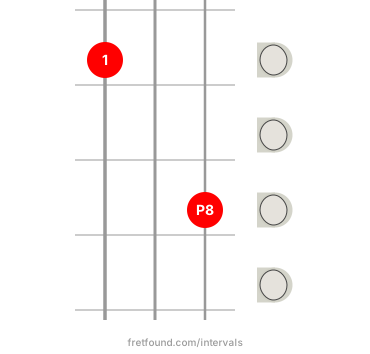
Many of the diagrams in these lessons include four little semicircles off to the side. I call this the "finger ruler". It shows how we can use the fingers of our fretting hand as a practical way to find the two notes of an interval shape on the fretboard. If we line our fingers up on the side of the fretboard, with one fret per finger, the little finger is three frets ahead of the index finger. Like this:
The third rail
In standard guitar tuning, the interval between the second and third strings is one fret less than the other pairs of strings. This gap between the second and third strings is sometimes called the "third rail"; partly because the interval between those two strings is a major third, and partly because (like the high-voltage third rail in a subway system) we have to pay attention when we cross it or else we'll get a shock.
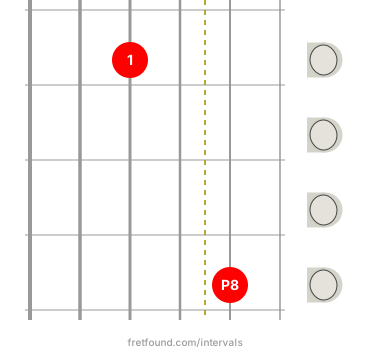
In the diagrams used here, the third rail is highlighted with a dashed line.
When an interval shape crosses the third rail, the stop on the higher-pitched string has to move forward one fret, or the stop on the lower-pitched string has to move backward one fret, compared to its main shape on other strings. Here's an example:
Related material
Interval Color Wheel
What's with all these interval colors?