
Fifths and Fourths
The most universal musical sounds across cultures and throughout history.
The perfect fifth and perfect fourth are the most commonly used musical intervals in the world, because they derive from a fundamental effect of acoustics I call the dominant overtone. For similar reasons, the fourth and fifth provide the framework of all chord progressions in Western harmony.
Like the other two perfect intervals, the unison and octave, the frequencies of two notes separated by a fourth or fifth overlap in a very simple way, which our brains perceive as especially consonant, relaxed, and stable.
Perfect fifth
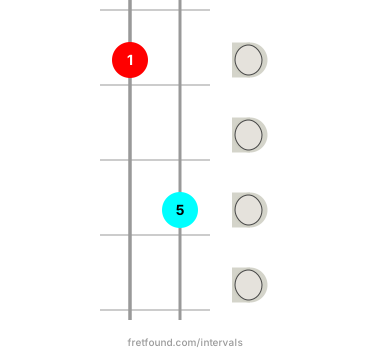
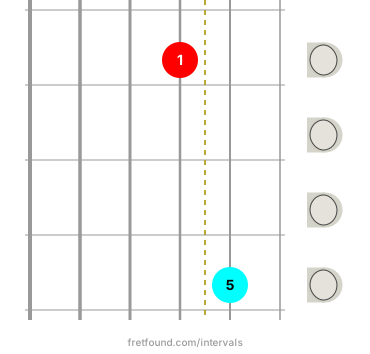
Perfect fifth ahead
The perfect fifth shape ahead is "one string over, skip a fret ahead".
Perfect fifth behind
The perfect fifth shape behind is "skip a string, skip two frets back", spanning four fingers with the finger ruler.
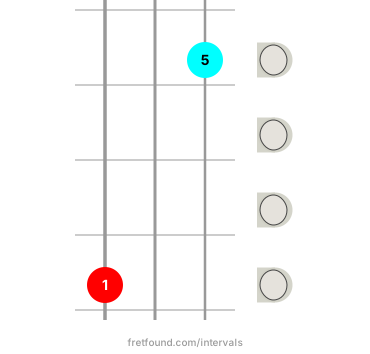
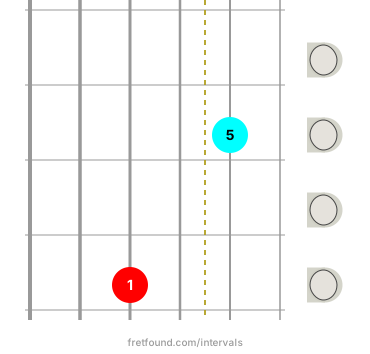
Notice how these perfect fifth shapes are on the same frets as the octave, but octave shapes are one more string over.
Perfect fifth on one string
On one string, the perfect fifth can be found seven frets ahead of the root ("skip six frets").

Perfect fifth character
The perfect fifth is the most common sound in music, across all human cultures and throughout history. This is because the perfect fifth is the dominant harmonic in the overtone series, a natural phenomenon of acoustics.
Overtones (harmonics)
When a string vibrates, the frequency at which the whole string vibrates back and forth determines the fundamental pitch that we hear. But sub-sections of the string are also vibrating separately at the same time, creating overtones or harmonics that we can hear if we know what to listen for (and which can be detected by instruments even if we can't hear them).
You've heard these overtones if you've ever played harmonics on guitar by gently touching a string in just the right spot, silencing the fundamental frequency while leaving the overtone to ring out.
The dominant overtone
Many of these overtones quietly riding on top of the fundamental pitch are octaves, which sound like the same note at a higher pitch. But the perfect fifth is the loudest overtone that is not an octave.
This is why the fifth is sometimes called the dominant. Whenever we hear any pitch, if we listen carefully we can also hear the pitch a perfect fifth above it, quietly ringing out at the same time.
For this reason I call the perfect fifth the dominant overtone, which I think helps clarify the material, but be aware that it's not a formally recognized term in music theory.
In chords, the fifth is optional
When voicing a major or minor chord, we can easily recognize the sound of the chord even if its fifth interval is left out altogether. In part this is because it's already there anyway, riding atop the chord root note as the dominant overtone. But also, since most chords contain a fifth, it doesn't provide any information to help distinguish one chord from another; it's not really needed. Our brains will sort of imagine it, or assume it is there, even if it's not being played.
Alternatively, a power chord includes only the root and fifth, which sounds strong and stable but ambiguous, because it is neither major nor minor.
Perfect fourth
The perfect fourth shape is "one string over, same fret".
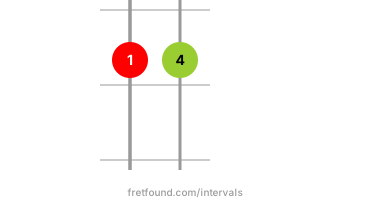
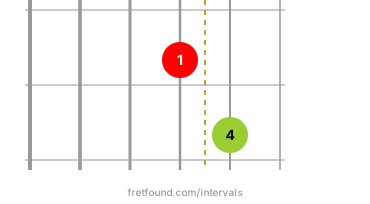
This convenient shape is often used when forming chord grips on the guitar, using the perfect fourth descending below the root as the inverted fifth of the chord.
Perfect fourth on one string
On one string, a perfect fourth can be found five frets ahead of the root ("skip four frets").

Perfect fourth character
The perfect fourth is one of the most stable and ancient sounds in music. It was once considered one of the most consonant intervals, and has been used as the basic method of tuning stringed instruments from Ancient Greece to the modern guitar.
Many non-Western cultures use quartal harmony, based on stacking fourths, instead of the Western practice of stacking thirds (tertian harmony). As harmony based on thirds became the standard in the West, the perfect fourth began to be seen as more dissonant, because it clashes with the major third a semitone away.
Subdominant
Interestingly, the distance from a perfect fourth to the octave is a perfect fifth. In other words, the fourth is a perfect fifth descending below the octave. These diagrams should make that clear:


This is why the fourth is sometimes called the subdominant. It's a perfect fifth ("dominant") descending below ("sub") the tonic.
Inverted intervals
Similarly, the distance from the perfect fifth to the octave is a perfect fourth. The fifth is a perfect fourth descending below the octave. These diagrams should make that clear.


Because we hear two notes an octave apart as the same note, this means that from a given root note, the notes a perfect fourth above and a perfect fifth descending below are the same note (in a different octave). Similarly, the notes a fifth above and a fourth descending below are also the same note.
Because of this relationship, perfect fourths and perfect fifths are called inversions of each other. Almost every interval can be inverted to another interval in this way.
Primary chords
The perfect fourth and perfect fifth provide the framework of chord progressions.
The three chords whose root notes are respectively on the 1, 4, and 5 of the key are called the primary chords of a song.
In a major key, these chords are called the I-IV-V ("one-four-five"), and they are the major chords in that key.
In a minor key, these chords are called the i-iv-v ("minor one-four-five"), and they are the minor chords in that key.
The primary chords are the framework of Western harmony, shaping the underlying structure of chord progressions, and orienting the function of other chords. See the Introduction to Western Harmony chapter of the Fretboard Foundation book for more information.
Exercises
Practice exercises
-
Find ascending fourths and fifths across strings. Pick a random location on the fretboard and find perfect fourth and perfect fifth intervals on the higher-pitched string.
-
Find descending fourths and fifths across strings. Pick a random location on the fretboard. Imagine that you are starting on the higher-pitched note of the interval, and find descending perfect fourth and fifth intervals on the lower-pitched strings.
-
Compare the fifth and octave shapes. Starting from random locations on the fretboard, play a perfect fifth and then an octave. Notice how they are on the same frets but one string apart (except in cases where the octave crosses the third rail and the fifth does not). Also notice how this reveals the fifth and octave are a perfect fourth apart.
-
Play thirds in I-IV-V progressions around the fretboard. Pick a random location on one of the lower-pitched strings for the 1, identify the location of the 4 and 5, and play major third intervals as 2-note chords rooted on the 1, 4, and 5. These are the major key primary chords. Then play minor third intervals as 2-note minor chords rooted on the 1, 4, and 5. These are the minor key primary chords.