
Tritones
The most dissonant interval and the core of dominant seventh chords.
Tritone shape
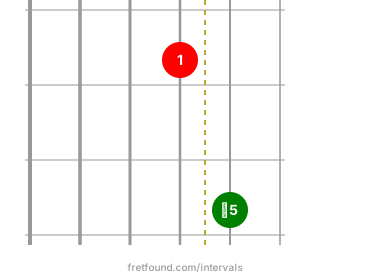
The tritone shape is "one string over and one fret ahead".
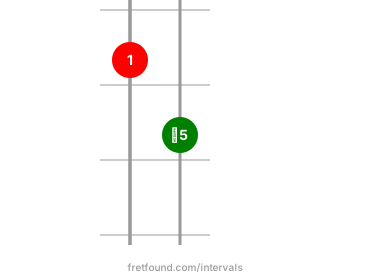
Tritone character
The tritone, or ♭5 ("flat five"), is the most dissonant interval in Western music. It creates a lot of tension and a strong desire for movement. Where sevenths make us a little uncomfortable before delivering us home, the tritone turns our world upside down and makes us feel we may never get home at all. Which just makes our return to the hearth that much sweeter.
Half-way to the octave
The distance from a tritone to the octave is another tritone. Since it's right in the middle of the chromatic scale, it's the only interval that inverts to itself.
It might seem confusing that the interval in the middle of the scale is the most dissonant, since the especially consonant perfect intervals are those that divide the string neatly into a few equal parts.
But the tritone is in the middle of the way we think about the chromatic scale. It's not physically in the middle of an octave on a string. These diagrams should make it clear:


Dominant seventh chords
The tritone is the defining sound of a dominant seventh chord, a tense chord that tends to spur movement toward the chord a perfect fifth below it.
Harmonically speaking, the tritone is the most important part about a dominant seventh chord. We can actually just play the tritone by itself, as a shell voicing of the chord, and get the full harmonic effect.
Resolving the V7 tritone to the I major third
This isn't the place to get very deep into discussions of harmony, but it's helpful to know that the dominant five chord in a major key, the V7 chord, has a tritone between two of its notes. And it's worth noticing this little trick of tritones and major third intervals, which underlies most theoretical ideas about which chords "want" to move to others or remain at rest.
The tritone in the V7 chord creates tension partly because it is so dissonant all on its own. But also, both notes of the tritone are each just one fret away (a dissonant minor second) from the core of the I chord--the major third interval sitting at its root.
Looking at the tritone and major third shapes side-by-side should help make this clear:
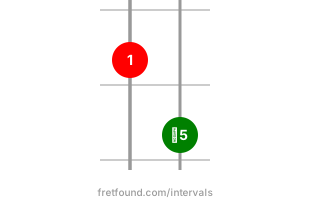
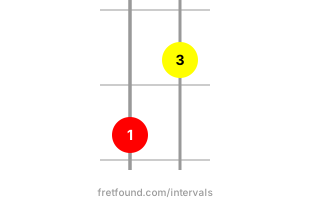
The tritone in the V7 chord resolves home to the major third in the I chord. The dissonant tritone resolves elegantly to the stable major third by moving each note one fret in opposite directions.
Exercises
Practice exercises
-
Find tritones across strings. Pick a random location on the fretboard and find tritone intervals on the adjacent higher-pitched string.
-
Find descending tritones. Pick a random location on the fretboard. Imagine that you are starting on the higher-pitched note of the interval, and find descending tritone intervals on the adjacent lower-pitched string.
-
Experiment with resolving tritones to major thirds. Explore resolving tritone shell voicings of V7 chords to major third shell voicings of I chords right next to them.