
Sevenths
The color and tension of seventh chords and the leading tone.
Sevenths are the main intervals in extended chords (seventh chords). They are used to create tension and color. They keep things moving and interesting by making us a little uncomfortable before delivering us safely home.
Major seventh
The major seventh shape is "skip a string and one fret ahead".
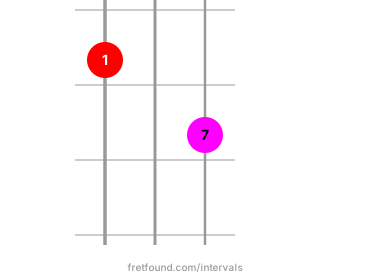
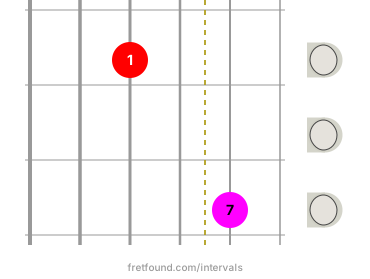
Notice that the major seventh shape is one fret behind the octave shape.
Major seventh character
The major seventh is just one fret behind the octave (that is, a minor second from the octave). As we've learned, the minor second interval is very dissonant. This dissonance, which creates tension and a desire to move to another note, coupled with a lifelong experience of hearing the major scale resolve in this way, creates a strong desire in the listener for the 7 to resolve to the octave 1.
The leading tone
The major seventh is known as the leading tone because it leads to the tonic. In other words, listeners tend to want to hear a major seventh resolve to the octave. This pull is strong and compelling, and it is the basic trick that underlies functional harmony (the theory that certain chords "want" to progress to certain other chords).
The move from the leading tone into the one is such an important trick that it can't be overemphasized. It's like sliding into home. We could walk over home plate, but sliding into home is just so much cooler.
Arriving at the one of the key (or the root of a chord) by way of the leading tone a half step behind it is such a compelling sound that it nearly always works. Even if the leading tone is outside the key or scale (also known as being a chromatic note). In fact, as is the case in minor keys, when we bring in a chromatic leading tone in order to slide into home, it actually sounds even better. It's more noticeable, more emotional, more heart-wrenchingly beautiful.
Improvising with the leading tone
Having the leading tone in our bag of tricks provides a safety net for improvisation. It helps us choose between two notes on the fretboard when we're not quite sure where the note we want is located. If we can get close enough, narrowing it down to probably one of two locations on either side of a fret, then we can land on the lower-pitched one and immediately start sliding or bending toward the higher pitched one.
If it turns out the note we landed on was the one we actually wanted, we stop sliding or bending and act like that was just a little flourish. If the note we landed on was a half step below the one we wanted, we keep sliding or bending, and it sounds like we were just sliding into home. Which, as already established, is cool.
Minor seventh
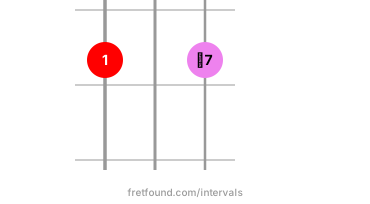
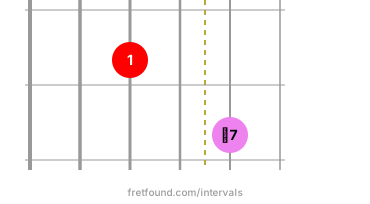
The minor seventh shape is "skip a string, same fret". Notice that it's two frets behind the octave.
Minor seventh character
The minor seventh is the extra interval added to triad chords to make minor seventh chords and dominant seventh chords. It creates a little tension that can seem haunting and familiar.
In minor keys, the minor seventh is "adjustable"; sometimes it's raised to a major seventh to get the leading tone effect. See the Minor scales chapter of the Fretboard Foundation book for more information.
Exercises
Practice exercises
-
Find ascending sevenths across strings. Pick a random location on the fretboard and find major and minor seventh intervals on the higher-pitched string.
-
Find descending sevenths across strings. Pick a random location on the fretboard. Imagine that you are starting on the higher-pitched note of the interval, and find descending major and minor seventh intervals on the lower-pitched strings.
-
Practice sliding into home. When you practice scales, practice landing on the major seventh and sliding into the one. When you practice chord changes, find cases where it sounds good to slide into the root of the chord from the note one fret behind it.